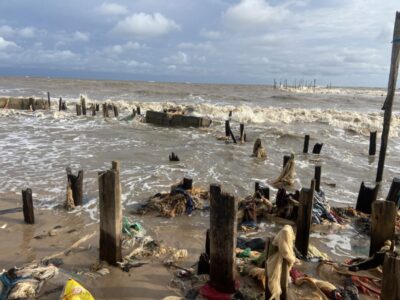
Aiyetoro now feels like a mother returning from a war front arms empty, eyes searching, heart heavy only to find that everything she once nurtured has been carried away by the tide. What was once a proud home, rich in heritage, faith, and communal strength, now stands like a fading echo. The sea does not shout when it takes; it advances quietly, inch by inch, until the land remembers too late what it has lost.
It is painful to watch a legacy slip through our fingers while those entrusted with its care stand by as if the storm will pass on its own.
Aiyetoro, once a shining example of collective living and shared purpose in West Africa, is dimming like the morning star at sunrise visible, yet vanishing. And this is happening in a time when a son of the soil holds power at the highest level. That contrast alone deepens the wound.
There is a proverb: when the fence begins to fall, it is not the fault of the wind alone, but also of those who failed to mend it in time. The religious leaders, who should awaken conscience and rally hope, have not spoken with the urgency the moment demands. Traditional leaders, custodians of identity and continuity, seem to watch history unravel without firm intervention. Political leaders, equipped with authority and resources, have not translated position into protection. None can claim innocence when the house collapses in their presence.
If nothing changes, one can already foresee a tragic irony kings without kingdoms, rulers without land, a people scattered like seeds with no soil to take root. Must we wait until the last pillar falls and the last family is displaced before we act? Already, many have lost their homes, and some, their sense of stability and dignity.
As echoed in the words of Lekan Remilekun, when a person watches their inheritance crumble despite having the means to rebuild it, their silence becomes a stain on their legacy. Responsibility ignored does not disappear; it returns as regret.
Yet even a grieving mother can rebuild if her children gather around her. This is a call not of anger alone, but of necessity to all sons and daughters of Ilaje, wherever they may be. The task before us is not small, but neither is our history. If the sea has taken, then unity must restore. If leaders have faltered, then the people must rise.
Aiyetoro, the “Happy City,” should not become a story told with tears alone. It must become a story of return, of rebuilding, of a people who refused to let their heritage drown.
We have a governor, NDDC representatives, and a local government chairman yet they stand like witnesses in a slow tragedy, watching heritage slip away in their very hands. Should this be called incompetence, or a painful absence of vision, when leadership watches history sink and does not act with urgency?
“Ikú tí ń pa ojúgbà ènìyàn, owe lo ń pa fún ni” when death stares one in the face, it is with proverbs we warn. Aiyetoro is crying, but its custodians are silent. Hunger for power has deafened ears, and self-interest has blinded eyes.
Let our traditional rulers remember: “ilé tí a fi ìtẹ́ mọ́, a kì í jẹ́ kó wó” a house built with care must not be allowed to collapse. If the elders sleep, the city will wither. It is time to rise, to act, and to save Aiyetoro before the river forgets its source