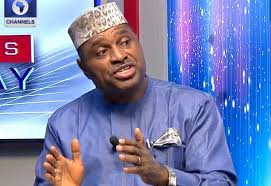
In a revelation that casts new light on the dynamics of Nigeria’s fiercely contested 2023 presidential election, Kenneth Okonkwo, a former spokesperson for the Labour Party (LP) and key member of the opposition coalition, has asserted that Peter Obi’s widely publicized pledge to serve only one term was a deliberate tactical maneuver. According to Okonkwo, the promise was designed primarily to assuage concerns among northern voters about political representation and power rotation—a sensitive and deeply entrenched issue in Nigerian politics.
The notion of a single-term commitment emerged against a backdrop of heightened regional tension. The North, which had held the presidency under Muhammadu Buhari since 2015, was particularly attentive to assurances that the next leader would not seek to monopolize power beyond one term. Okonkwo, speaking during an appearance on Channels Television’s Sunrise Daily on Friday, suggested that Obi’s team recognized these concerns and crafted the pledge as a “confidence-building measure” aimed at making the candidate more palatable to voters in the region.
This was not merely a personal promise but a strategic effort to disrupt the traditional voting patterns that often align along regional and ethnic lines. By offering a self-limiting term, Obi—a former governor of Anambra State from the Southeast—sought to position himself as a unifying figure willing to prioritize national stability over prolonged incumbency.
Okonkwo, who was deeply involved in the Labour Party’s campaign architecture, framed the pledge as a reflection of both principle and pragmatism. “It was a message to the North: ‘I am not here to deny you your turn after me,’” he explained. The idea was to ease fears that an Obi presidency might extend beyond one term, thereby delaying the return of power to the northern region.
This calculated approach also served to distinguish Obi from his main rivals—Bola Tinubu of the All Progressives Congress (APC) and Atiku Abubakar of the People’s Democratic Party (PDP)—neither of whom made similar commitments. In doing so, the Obi campaign attempted to redefine the terms of electoral competition, emphasizing accountability and restorative governance over prolonged tenure.
The declaration was met with both praise and skepticism. Supporters hailed it as a bold statement of integrity and sacrifice, while critics questioned its feasibility and underlying motives. Some political analysts interpreted it as a clever, if risky, electoral strategy—especially given the history of unmet promises in Nigerian politics.
What remains unclear is whether the pledge significantly influenced voter behavior, particularly in the northern states where traditional party loyalties and socio-religious factors often dominate electoral choices. Okonkwo’s comments suggest the campaign believed it had to make an overt gesture to break into these constituencies.
Okonkwo’s retrospective analysis opens a broader conversation about the role of term limits and power rotation—often referred to as zoning—in Nigeria’s democratic system. It underscores the continuing salience of regional equity in presidential politics and the lengths to which candidates must go to build cross-national coalitions.
Furthermore, his insight invites a reexamination of how campaign promises are crafted not only to appeal to values of transparency and reform but also to navigate complex geopolitical realities. The one-term pledge may have been as much about political survival as it was about idealism.
Peter Obi’s one-term promise will likely be remembered as one of the most distinctive features of the 2023 presidential race. Whether viewed as a sincere commitment or a strategic necessity, it highlights the evolving—and often contentious—interface between regional politics and national ambition in Nigeria.