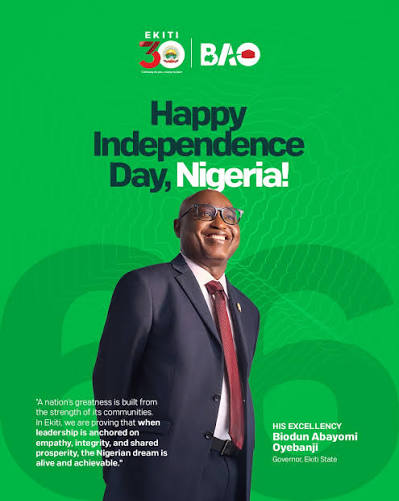
Ekiti State Governor, Biodun Oyebanji, has used the state’s 30th anniversary to set out a long-term economic vision aimed at moving Ekiti beyond its traditional civil service identity and towards technology, agriculture, enterprise and innovation.
In a statewide broadcast on Thursday, marking the anniversary of the state’s creation on October 1, 1996, the governor said the next phase of development must build on the progress recorded over three decades. He unveiled a 30-year transformation agenda under the theme, “Ekiti at 30: Celebrating the Past and Creating the Future.”
The proposed plan covers agricultural production and agro-processing, technology and innovation, education, research and skills development, tourism, the creative economy and youth entrepreneurship. According to the governor, the objective is to turn existing infrastructure and human capital into stronger economic activity, employment and improved living standards.
A major component is the Ekiti Knowledge Zone, a technology and economic development project in Ado-Ekiti. The state government says the project is designed to support innovation, research, skills development and technology-driven industries, with the first phase projected to create more than 20,000 jobs and the wider project expected to support up to 100,000 jobs.
Oyebanji also identified the Special Agro-Processing Zone as another project expected to support the state’s economic expansion. He said the two initiatives, alongside investments in education and skills, are intended to create an economy driven more by productivity and private enterprise than dependence on government employment.
As part of the forward-looking approach, the governor announced a youth engagement scheduled for October 7 at the Obafemi Awolowo Civic and Convention Centre in Ado-Ekiti. He said the session would provide an opportunity to reflect on the state’s journey, examine its present position and discuss practical expectations for the future.
Ekiti was created alongside five other states in 1996 after years of agitation by traditional rulers, professionals, politicians and community leaders. Thirty years later, the governor says the challenge is no longer simply the creation of a state, but building an economy capable of creating opportunities for its growing population and positioning Ekiti as a technology and commercial centre over the next three decades.