Promises and Pressure: Inside OSOPADEC’s Push to Deliver in Ilaje
ILAJE, ONDO STATE — The messaging was tight, the optics carefully managed. What looked like a routine inspection tour was, in fact, a high-stakes performance by Prince Biyi Poroye, Chairman of the Ondo State Oil Producing Areas Development Commission (OSOPADEC), designed to reassure a skeptical public that long-promised infrastructure in Nigeria’s oil-producing riverine communities would finally be delivered.
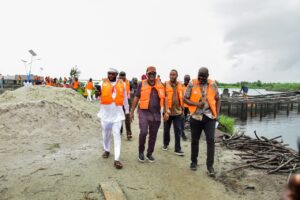
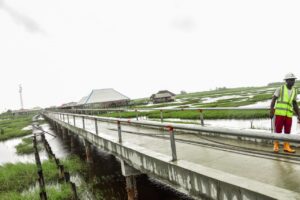
At the center of this effort: two projects with political weight and logistical complexity. The first—a ₦1.7 billion, 1,000-meter concrete walkway in Obe-nla—has been touted by the administration of Governor Lucky Aiyedatiwa as a landmark achievement. The second, a ₦236 million water treatment scheme in Molutehin, is said to be 85% complete and promises clean water in a region where residents have, for decades, relied on external sources, including Delta State.
Poroye’s visit, staged as a development tour, carried a deeper objective: restoring trust in a commission whose track record on project delivery has drawn criticism over the years. He emphasized speed, quality, and urgency. “This is not just a walkway,” he said. “It’s a lifeline.”
Behind the rhetoric, however, are tough questions OSOPADEC has yet to fully answer.
The walkway in Obe-nla—engineered by Dolban Technical Ltd., with oversight from Riyadh International Ltd.—has become the centerpiece of the Commission’s messaging. It replaces a deteriorating wooden footbridge that had, for years, symbolized neglect in the region. The project was awarded in 2024, part of Governor Aiyedatiwa’s broader infrastructure push in oil-producing communities.
While the contractor claims the project will be completed in 60 days, timelines in the region have historically been fluid. A 2019 audit of OSOPADEC projects—never released publicly—flagged several initiatives that were either abandoned or delivered far behind schedule.
Poroye, aware of the Commission’s credibility deficit, was quick to project accountability. He promised to personally invite the Governor for commissioning once the walkway is completed and called on federal agencies like the Niger Delta Development Commission (NDDC) to replicate the model.
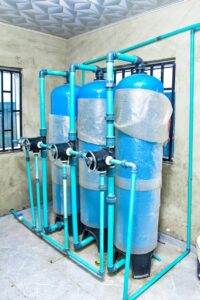
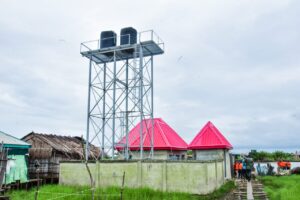
The Molutehin Mini Water Scheme tells a more complicated story. Originally budgeted at ₦82.3 million, the project cost has nearly tripled due to scope expansions—boreholes, a generator house, and additional pipelines. Project engineer Victor Erukubami insists the upgrades were essential to meeting the region’s water demands, and that the system, based on reverse osmosis, will deliver 20,000 gallons of clean water daily.
Poroye’s comments at the site were personal and pointed. “In 2025, no community in Ondo State should be importing sachet water,” he said. “Access to clean water is not a luxury. It is a right.”
Still, the timeline remains unclear. The 85% completion figure, a common placeholder in Nigerian project reporting, offers little insight into the actual readiness of the plant or its distribution infrastructure. Sources close to OSOPADEC have acknowledged internal delays tied to cash flow, citing procurement bottlenecks and the state’s rigid mobilization policy.
Poroye, perhaps unintentionally, drew attention to the Commission’s own limitations when he suggested that current contractor mobilization—typically capped at 30%—is insufficient to sustain project momentum. “If we give 50%, we can keep contractors on site until completion,” he said.
That statement raises broader policy questions. Why has OSOPADEC not revised this mobilization threshold earlier? What mechanisms exist to track funds once they are disbursed? And what oversight—if any—is in place to ensure the projects don’t suffer the same fate as previous ones?
For now, both projects—one physical, one potable—represent OSOPADEC’s attempt to reclaim public confidence and justify its budgetary allocations.
Poroye, whose tone blends populist urgency with bureaucratic realism, ended the tour with a line that could serve as both aspiration and warning:
“We’re not just building structures,” he said. “We’re building dignity, safety, and opportunity for our people.”
Whether the Commission delivers on that statement—or adds it to the long ledger of unmet promises—will depend not on speeches or site visits, but on execution, oversight, and the political will to sustain progress after the cameras are gone.